There’s one question that almost all of our patients ask before making a decision: “How long will I be out of commission?”
We don’t blame you. You have a job, a life, and commitments. And let’s be honest: the idea of showing up at a school meeting with a face that looks like a water balloon isn’t exactly your plan. The good news is that the post-operative period after a facelift follows a very predictable timeline. And if you know what to expect at each stage, it stops being scary and starts feeling like just another step in the process.
This guide is designed to help you arrive at your surgery (or your first appointment at our clinic in Barcelona) knowing exactly what will happen, when, and why. No sugarcoating, no empty promises.
How long does it take to recover from a facelift?
The short answer: 2 to 4 weeks to get back to your social life, and between 4 and 6 weeks to resume full physical activity.
The most helpful answer: It depends on which procedure you have. A mini facelift (which is the most common procedure for patients aged 40 to 55 who want to correct sagging in the lower third of the face without major surgery) has a significantly shorter recovery time than a full facelift or rhytidectomy.
Mini-facelift | Full facelift | |
Back to Remote Work | 5–7 days | 10–14 days |
Return to in-person work | 10–12 days | 14–18 days |
First "normal" outing | Week 2 | Week 3 |
Light exercise | Weeks 3–4 | Weeks 4–5 |
Final results | 3–4 months | 4–6 months |
Week by week: what's really going on
The first 48 hours: the most intense (and shortest) part
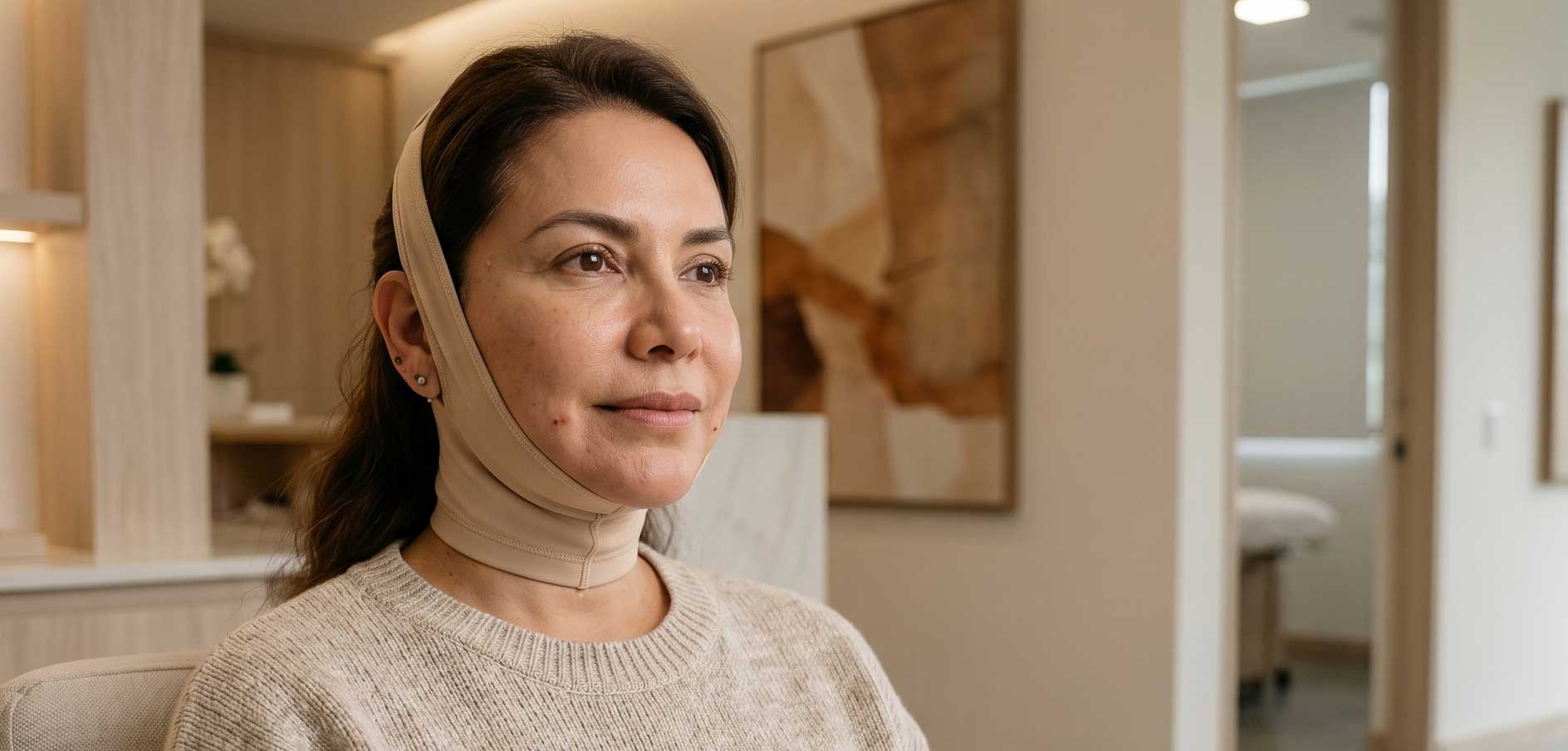
You’ll leave the operating room with a bandage covering your neck and part of your face. This is the most uncomfortable part of the entire process: you’ll feel some tightness, some numbness, and yes, there will be some swelling. What you won’t experience (contrary to what many patients fear) is severe pain. Most people describe it as a feeling of pressure, not sharp pain.
Basic guidelines for the first few hours: keep your head elevated (no lounging around on the couch), apply ice wrapped in a cloth to the areas we indicate, and take it easy. You can watch a movie. But no wine—not yet.
Week 1: The peak of inflammation
This is the week when you’ll want to stay home, and that’s completely normal. Bruises start to appear (and are to be expected), the swelling is at its peak, and you still have stitches. We usually remove them between the 5th and 7th day at our clinic in Barcelona, and that moment often brings a huge sense of relief.
What you must avoid at all costs: exposure to heat (saunas, very hot baths, steam), physical exertion, and, especially, direct sunlight on the scars.
Signs that something isn't right: a fever over 38°C, severe asymmetrical pain, or redness that gets worse instead of better. If you notice any of these symptoms, give us a call. That's what we're here for.
Week 2: The change no one warns you about—and that will surprise you
This is the "Is this normal?" week. The swelling starts to go down, but not evenly: one side may improve before the other, you may experience some itching (a sign that the nerves are healing), and the skin may feel tight and a little strange to the touch.
It’s also the week when many patients look in the mirror and still don’t see the results. This is completely normal. What you see now isn’t the result; it’s the process. The final results will come, but not yet.
If you're working from home, you'll likely be able to resume video calls this week—with good lighting and a flattering angle, since we've had years of pandemic training to prepare us for this.
Weeks 3 and 4: Back to Real Life
Here’s where the good part begins. The visible swelling has gone down by 60–70%, the bruises have disappeared or can easily be covered with makeup (which you can start using as early as the second week in most cases), and you start to recognize yourself in the mirror in a way you like.
At this stage, most of our patients return to working in person, dining out with friends, and their daily lives in Barcelona without anyone noticing anything other than that “they’ve been looking really well lately.”
From month 2 to month 3: when the results become final
Any remaining inflammation finally subsides, the scars begin to fade (turning from pink to increasingly less noticeable), and the skin’s sensitivity returns to normal. This is also when the results of the facelift become fully apparent.
If, after three months, there are still areas you’re not happy with, talk to your surgeon. This is the ideal time to assess whether any adjustments are needed or if the area simply needs more time to heal.
When can I go back to the gym after a facelift?
One of the most frequently asked questions we receive at our facelift clinic in Barcelona is exactly this one. And the answer has to be honest: too soon, exercise doesn’t speed up recovery—it puts it at risk.
The reason is physiological: physical exertion increases blood pressure and blood flow in the area where the surgery was performed, which can reignite inflammation, compromise the sutures, or cause delayed bruising.
Activity | When can you get back to it? |
A leisurely stroll (a walk through the Eixample) | Week 2–3 |
Restorative yoga / gentle stretching | Weeks 3–4 |
Low-impact cardio (stationary bike, elliptical trainer) | Weeks 4–5 |
Swimming | Weeks 5–6 |
Weight training, HIIT, CrossFit | 2 months and older |
Intense activity without restrictions | Month 3 |
Here’s the rule of thumb we give during consultations: if, while doing the activity, you notice that your face turns very red or you feel a throbbing sensation in the area where you had surgery, it’s too soon.
Scars: Where They Form and How They Heal
This is the other major concern, and it’s completely legitimate. The first thing to know is that in a well-planned facelift, the scars are hidden: in front of the earlobe, following the natural crease, behind the ear, and extending toward the scalp. With your hair down (or even in a ponytail), they’re practically invisible.
Progress is slow but steady:
- Months 1–2: The scar may be pink and slightly noticeable to the touch.
- Months 3–4: It flattens out and begins to lighten.
- Months 6–12: in most cases, it is practically imperceptible.
What helps the most: applying sunscreen to the scars (yes, even in winter in Barcelona—the Mediterranean sun can be deceiving), gentle massage as directed by your surgeon, and avoiding tobacco throughout your recovery. Tobacco is the worst enemy of healing—there’s no way around it.
Practical tips for a faster recovery

None of these are revolutionary, but the difference between following them and not following them is clear:
Eat anti-inflammatory foods. Ginger, turmeric, berries, omega-3. No processed foods or alcohol during the first few weeks. Yes, we know the weekend is the weekend, but your face will thank you for it.
Sleep on your back with your head elevated. Use an extra pillow for the first three weeks. It’s uncomfortable at first, but you’ll get used to it.
Don't smoke. If you smoke, now is the time to quit: at least 4 weeks before and 4 weeks after. Smoking reduces blood flow to the skin and can seriously impair healing.
Don't judge the results before the third month. What you see in week 2 isn’t the final result. Neither is what you see in month 1. A facelift takes time to settle in, and judging it too soon is an unnecessary source of anxiety.
Frequently Asked Questions About the Postoperative Period Following a Facelift
How many days of sick leave do I need after a facelift?
Between 10 and 14 days if you work in person. If you work remotely, you can resume in 5–7 days via video calls without any issues.
When does the swelling from a facelift go down?
70% of the swelling subsides within the first two weeks. Residual swelling may last up to three months, but by week 3 it is no longer visible to others.
Can I sleep on my stomach after a facelift?
Not during the first 3–4 weeks. Keep your head elevated and lie on your back to minimize swelling.
Are the scars from a facelift noticeable?
If applied properly, no. After 6–12 months, they’re practically invisible against your natural hair.
When will the final results be available?
Between 3 and 6 months, when the scars have healed and the skin regains its natural elasticity.
Do you have questions about what your recovery process would look like specifically? At Clínica Belba, we offer a personalized consultation with no obligation. Every face is different, and so is the treatment plan.
- Dr. Mike Dewever
- April 30, 2026
- 5:40 p.m.